
Your dog nails the recall in class. Sits the first time, every time, in front of the trainer. Then you get home, ask for that same sit in your own kitchen, and it is as if the last six weeks never happened.
I hear this constantly, and it almost always arrives with an apology attached — the owner assumes they have not practiced enough, or that their dog has decided to be stubborn. Neither is usually true. Dog obedience problems at home are typically a different problem wearing an obedience costume, and the actual name for it is generalization.
Here is the short version. Your dog did not learn “sit.” Your dog learned something far more specific than that, and your kitchen was not part of it.
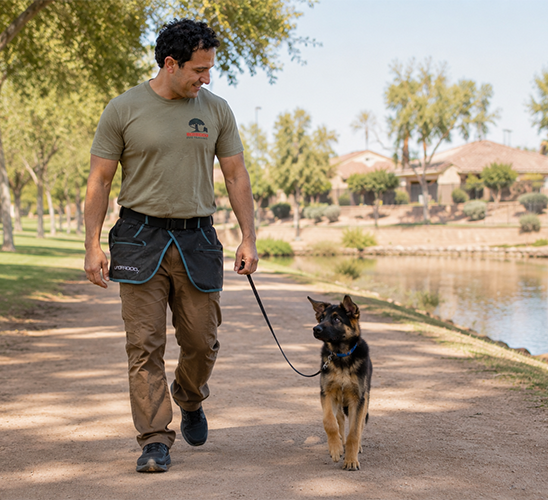
Dog Obedience Problems at Home Are Usually Not Obedience Problems
Most dog obedience problems at home are generalization failures rather than disobedience. Your dog learned the behavior attached to one specific set of surroundings, and when those surroundings change, the cue stops being recognizable. The behavior was never broken. It was only ever installed in one place.
This distinction matters because it changes what you do next. If you believe your dog is being defiant, escalation feels like the logical response — repeat the cue louder, add pressure, get firmer. If you understand the dog simply does not recognize the question, all of that is noise. You are raising your voice at a dog who is genuinely confused.
Generalization is one of the most thoroughly documented phenomena in behavioral science, and it is also the single concept that explains more everyday training frustration than anything else I teach. It is not an advanced topic. It is the thing nobody told you when you signed up for a six-week class.
What Your Dog Actually Learned (It Was Never Just the Word)
Dogs learn cues as a whole package, and the word is only one ingredient. Your body position, the room, the floor surface, the treat pouch on your hip, the time of day, and whatever else was happening all get bundled in. Change enough of that package and your dog no longer recognizes the cue.
Picture how the behavior was actually taught. You were standing in your living room, facing your dog, treat pouch on your hip, carpet underfoot, nothing else going on. You said “sit” a few hundred times in roughly that arrangement, and your dog got very good at it.
Now you are in the kitchen. You are side-on to the dog because you are chopping something. Your hands are wet. There is no pouch. Dinner smells are everywhere and the tile is slick. You say the same word. From your dog’s point of view, almost nothing about this matches the thing they learned. The word survived. Everything around it changed.
I came to dog training after two decades of coaching human athletes, and this is one of the places the two fields line up almost exactly. In strength training we talk about specificity: you get good at the thing you actually practice, under the conditions you practice it in. An athlete who has only ever squatted in one rack, with one bar, in one warm-up sequence, is measurably less reliable the first time they step into a different gym. Same lift on paper. Different performance, because the setup was part of the skill.
Your dog is not ignoring the cue. Your dog is not certain that was the cue.
Why Does My Dog Only Listen Sometimes?
“Sometimes” almost always maps onto context rather than mood. If you write down when it works and when it does not, a pattern appears within days: the behavior holds where it was taught and degrades everywhere else. That is generalization behaving exactly as expected, not a dog choosing when to cooperate.
Try this before you change anything about your training. For one week, every time you cue a behavior, note four things: where you were, what your body was doing, who else was present, and whether it worked. Most owners come back genuinely surprised. The dog they described as unpredictable turns out to be extremely predictable once the variables are written down.
These are the things that most often change the picture without owners noticing:
- Location. Not just indoors versus outdoors — a different room counts as a different place to a dog who has not practiced there.
- Your body. Standing versus sitting, facing the dog versus side-on, cueing from across the room versus up close.
- Visible food. A pouch on your hip is part of the cue until you deliberately teach otherwise.
- Who else is there. Another person, another dog, or your kids moving around all change the picture.
- Surface. Tile, gravel, and grass feel different underfoot and genuinely matter to some dogs.
- Leash or no leash. For many dogs these are two separate behaviors until they are trained as one.
None of these are excuses. They are the working parts of the problem, and they are all things you can change on purpose.
Why Won’t My Dog Listen Outside?
Outdoors stacks two problems on top of each other. The context is entirely new, so the cue is harder to recognize, and the environment is full of competing rewards your living room never contained. When a dog ignores commands outside, you are usually watching both at once: a weakly generalized cue and a much better offer.
It is worth learning to tell those two apart, because they need different responses and owners routinely treat them as the same thing.
- If your dog can still take food and still checks in with you but responds slowly, offers the wrong behavior, or needs the cue twice — that is a generalization gap. Go back a step and rebuild in this new place.
- If your dog will not take food at all and cannot break a stare at whatever has their attention — that is not a generalization problem. Your dog is over threshold, and no amount of cue practice will reach them in that state.
That second case is a different piece of work entirely. We covered it in detail in our guide to leash training and arousal in Phoenix, and if the refused-treat description sounds like your dog, start there instead. Training a cue into a dog who cannot currently process information is wasted effort, and it teaches the dog that your cue is something that happens while they ignore you.
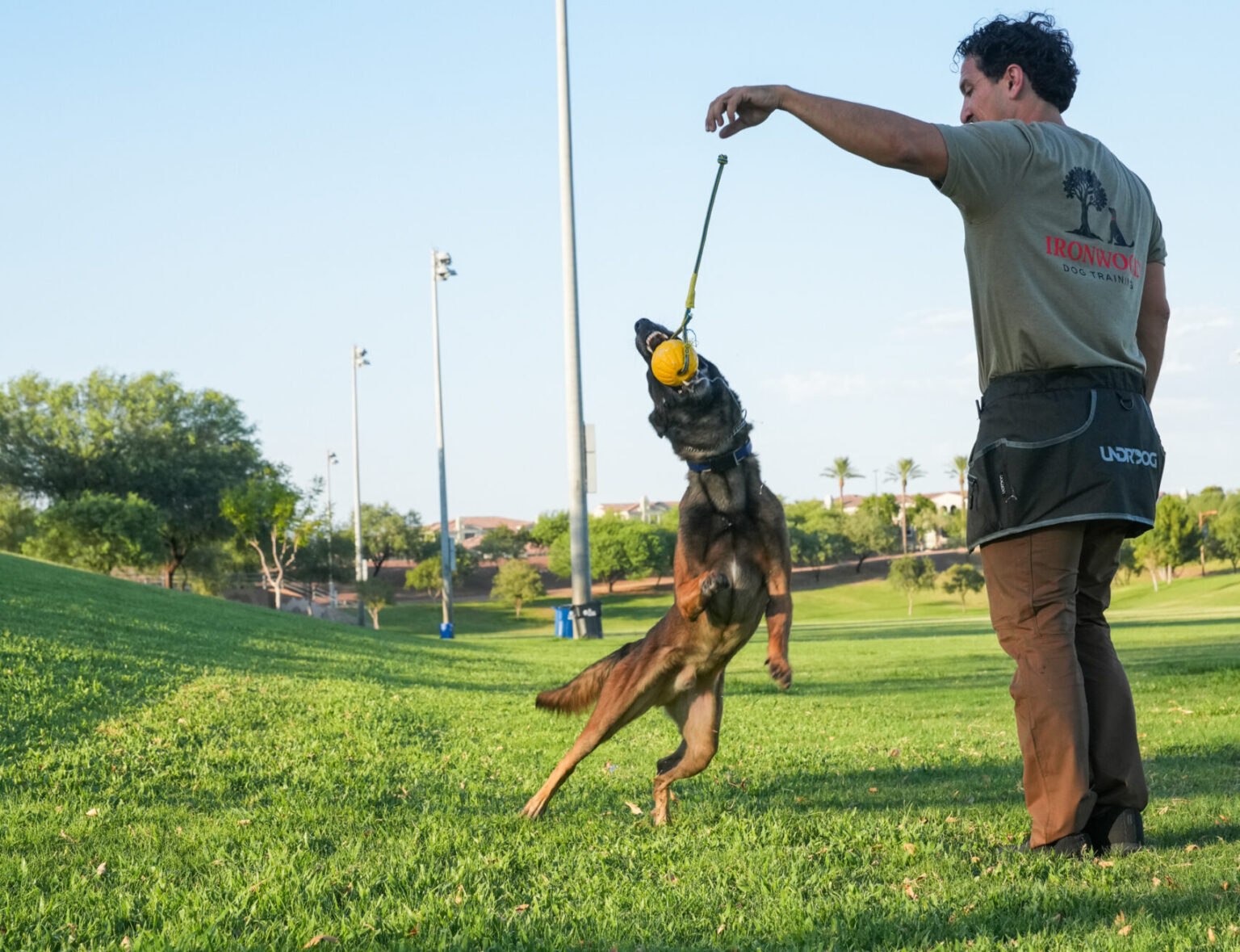
How to Train a Dog to Listen in Different Environments
Generalization is trained by deliberately changing one variable at a time and rebuilding the behavior in each new picture. Expect performance to drop the first time in every new place. That drop is normal, it is temporary, and planning for it is the difference between progress and a discouraging afternoon.
- Change one thing at a time. A new room before a new building. A new building before an open outdoor space. Stacking three changes at once tells you nothing about which one broke it.
- Drop the difficulty when you change the context. Shorter duration, shorter distance, better reward. You are not being soft — you are keeping the dog successful long enough to recognize the pattern.
- Pay the early repetitions generously. The first few reps in a new place are the ones doing the actual teaching.
- Vary yourself, not just the room. Cue while sitting. Cue side-on. Cue with your hands full. Cue with the pouch in a drawer. Your dog needs the word to survive without you as scenery.
- Count first-rep failures. In each new location, note whether the very first repetition succeeds. Early on, most will not. As generalization builds, that number falls — and it is a far cleaner signal than how the session felt.
That last one is the piece of programming I brought over from coaching, and it is the one owners tell me changed how they practice. A session can feel bad and still be productive. A single tracked number across three weeks tells you the truth.
Sport is where this stops being optional. My own dog, Saruk, earned his Protection Dog Certificate in October 2025, and in that setting the field is unfamiliar, the helper is a stranger, and the surroundings are nothing like where the work was built. Nobody gets to bring their training field to the trial. Generalization is not a refinement in sport — it is the entire test. The same is true of the bird dogs I work with: a pointer who only performs in one familiar field is not actually a bird dog yet.
How to Get Your Dog to Listen Better: A Realistic Two Weeks
Pick one behavior, not five. Practice it in five genuinely different places across two weeks, a few minutes at a time. Reward the first repetition in each new place heavily. You are not teaching the behavior again — you are teaching your dog that the cue means the same thing no matter where you happen to be standing.
Most owners try to generalize everything at once and end up making slow progress on all of it. One behavior, properly generalized, also teaches your dog something broader: that cues carry across places. The second behavior goes faster, and the third faster still.
In August in Phoenix, outdoor variety is limited, and that is fine — the constraint is smaller than it looks. Different rooms, the garage, a hallway, a stairwell, a friend’s living room, a covered parking structure, and a quiet pet-friendly store between them give you more distinct contexts than most dogs get in a year. Context variety is what you are after, not distance covered.
Not “my dog never fails.” A dog who fails the first repetition in a brand new place and gets it on the second or third is showing you exactly what you want to see. The recovery is the skill. Perfect first reps in a familiar room tell you almost nothing.
How We Build Generalization at Ironwood
We treat generalization as its own training phase rather than something we hope happens on its own. Behaviors get built in a low-distraction setting, then deliberately rebuilt across rooms, surfaces, handlers, and outdoor locations — with the owner running repetitions too, because a dog who only listens to the trainer has the same problem in a new costume.
That last point is why the handoff matters so much in our board and train program. A dog can finish an intensive program genuinely reliable with me and still come home and fall apart, because I was part of the picture the behavior was learned in. The handoff is not a formality at the end. It is the final generalization step, and we schedule real time for it.
Which program fits depends on your dog. Cue clarity across contexts is the backbone of our basic obedience training. With a young dog, building cues in varied settings from the start is far easier than repairing a context-bound cue later, which is how our puppy training program is structured. And if you are newer to reward-based training generally, our beginner’s guide to positive reinforcement covers the mechanics this article builds on.
On methods, we are straightforward: we do not use prong collars or e-collars as primary training tools. This is not a stylistic preference. The American Veterinary Society of Animal Behavior recommends reward-based methods for all dog training and behavior modification in its 2021 Humane Dog Training Position Statement, and that reflects where the evidence sits. It is also practical: a behavior maintained by avoidance tends to be even more context-bound than one maintained by reward, because the dog is tracking whether the consequence is currently possible.
“Luna was peeing everywhere and crying all night in her crate. After just 2 weeks, she goes to the door when she needs to go out and sleeps quietly through the night. The trainer showed me exactly what to do — no confusing advice, just simple steps that worked. Now when I say ‘go potty,’ she knows exactly what I mean!”
I include that one deliberately, because it shows the starting point rather than the finish line. “She knows exactly what I mean” is cue clarity in one context, and for house training that happens to be the context that counts. For a recall it would not be. That is the whole distinction this article is about.
One honest limit: generalization work assumes your dog can function in the new environment. If your dog cannot eat, cannot look away from a trigger, or is showing real fear in a place, more repetitions will not help and may make things worse. That is a different assessment and sometimes a veterinary behaviorist’s call. We will tell you if we think that is what we are looking at.
Frequently Asked Questions
Why does my dog listen at training but not at home?
Because the behavior was learned attached to the training environment, the trainer, and everything else present at the time. Your home is a different picture, so the cue is less recognizable. The fix is to rebuild the same behavior at home rather than assume it should transfer on its own.
How long does it take for a dog to generalize a behavior?
It varies by dog and by how many contexts you practice in. Many dogs need a handful of distinct locations before a cue starts holding up in genuinely new places. The useful measure is not weeks elapsed but how often the first repetition in a new location succeeds.
Is my dog being stubborn, or does he not understand?
Check whether the same cue works reliably in the place it was taught. If it does, understanding is not the issue — recognition in the new context is. Dogs do not generally selectively obey based on attitude; they respond to how closely the current picture matches the one they learned.
How do I get my dog to listen without repeating the cue?
Repeating teaches your dog that the cue means “get ready, the real one is coming.” Say it once. If nothing happens within a few seconds, make it easier rather than louder: move closer, reduce distractions, or go back to a setting where it works, then rebuild from there.
Does my dog really need to relearn everything in every room?
Not forever. The first few behaviors take deliberate work in each new setting, but dogs learn the broader pattern that cues carry across places. After several well-generalized behaviors, new ones transfer noticeably faster with much less rebuilding required.
My dog listens to the trainer but not to me. Why?
The handler is part of the picture. Timing, body position, and reward delivery all differ between people, so from the dog’s side you are asking a slightly different question. This is why our programs include real handoff sessions where you run the repetitions yourself.