
Most people who find us typed something like dog leash training Phoenix into Google at 5:30 in the morning, right after another walk went sideways. Usually there is one specific moment behind that search: your dog spotted another dog across the canal path, locked on, and stopped hearing anything you said.
Here is the single most useful thing I can tell you about that moment. It was not disobedience. It was arousal. And arousal is a trainable variable, not a personality trait.
I spent two decades coaching human athletes before I started training dogs, and I have been in the dog world for six years now. In strength coaching you learn quickly that performance is not just about whether an athlete knows the movement. It is about what state they are in when they attempt it. Dogs are no different. The dog who heels beautifully in your kitchen and falls apart on 7th Street has not forgotten the behavior. He has left the state where he can access it.
That distinction is what this guide is about, and it is the part most leash training advice skips entirely.
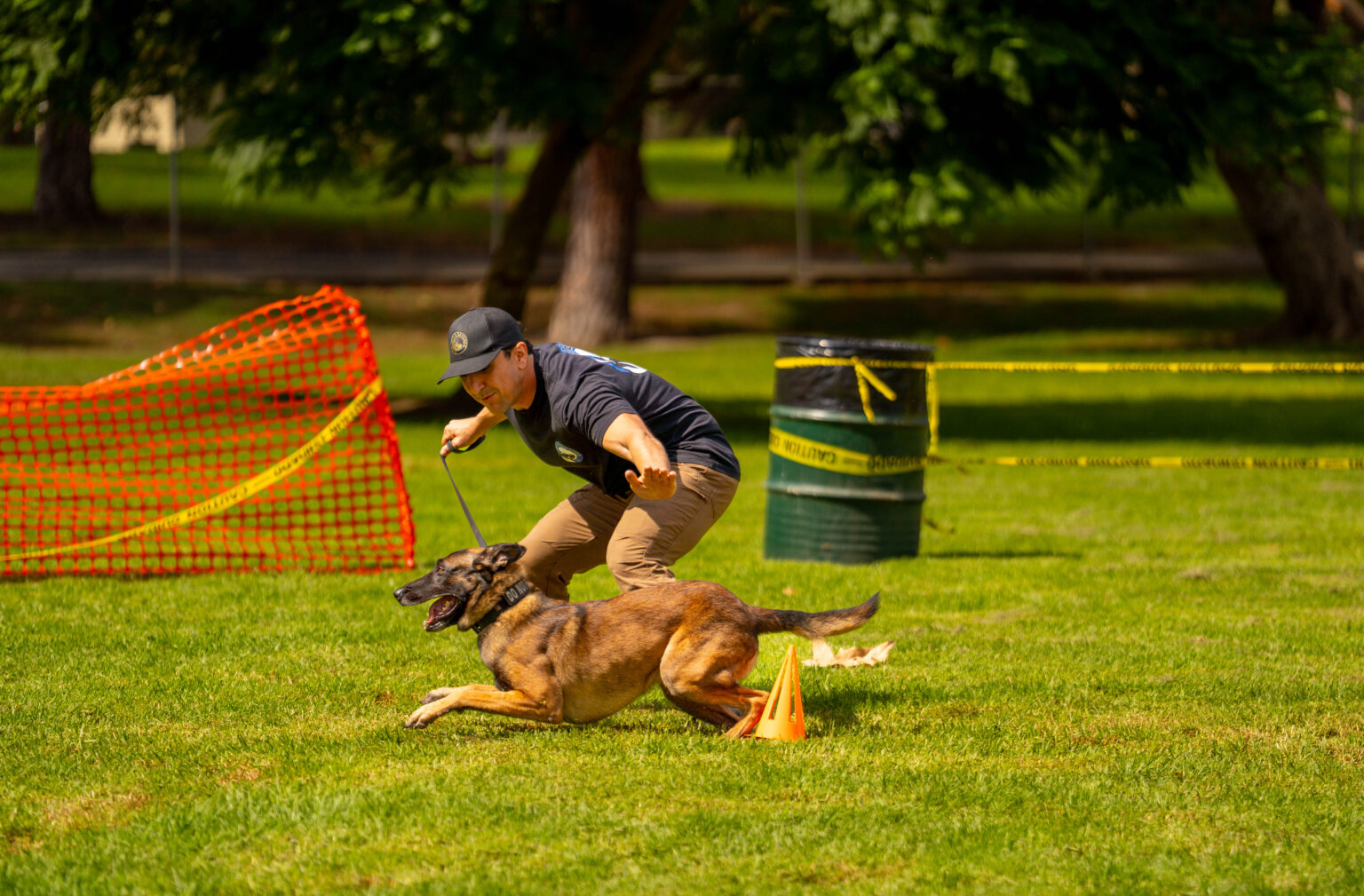
What Dog Leash Training in Phoenix Actually Involves
Dog leash training in Phoenix means building two separate skills, not one. The first is mechanical: walking near you without tension on the line. The second is regulatory: staying in an emotional state where your dog can still think. Most programs train only the first. In a city this hot and this crowded, the second decides whether the first holds up.
The mechanical side is well understood, and we have already written it up in detail. If your dog leans into the leash and drags you down the block, the underlying reason is a reflex plus a long reinforcement history, and the fix is systematic shaping. That is covered in our guide on how to stop a dog pulling on the leash, and I would read that one first if pulling is your main problem.
This article is about the other half. Because here is what I see constantly in Phoenix: owners who have done the mechanical work, whose dog genuinely knows how to walk on a loose leash, and who still cannot get through a single walk without a blow-up. The skill is there. The state is not.
Drive and Arousal Are Not the Same Thing
Drive is what your dog wants: the bird, the ball, the squirrel, the other dog. Arousal is how activated your dog’s nervous system is while wanting it. A dog can have very high drive and still be calm. Problems start when arousal climbs high enough to crowd out the ability to process information.
This distinction comes straight out of the sport dog world, and once you have it, a lot of frustrating dog behavior stops looking mysterious.
I train a lot of German Shorthaired Pointers, and they make the point better than any explanation I can write. A GSP is outwardly motivated, intelligent, and independent. She is bred to leave you, cover ground, and find birds. Obedience runs directly against that wiring. I had a Deutsch Kurzhaar named Libby in for training, and by day three the work was not teaching her commands. It was teaching her how to hang out. How to have all that drive available without living at the top of it. My standing joke is that if you can obedience train a GSP, you can train almost any dog, and I stand by it.
My own dog, Saruk, earned his Protection Dog Certificate in October 2025. In that sport, the dog has to go from full engagement to complete stillness on cue, repeatedly, under pressure, in front of strangers. Nobody wins anything by having a dog with less drive. They win by having a dog who can turn the volume up and back down on command.
There is a well-established relationship in performance research, usually drawn as an inverted U, between arousal and performance: too little and nothing happens, too much and performance collapses. Human athletes live on that curve. So do dogs. Your dog on a Phoenix sidewalk at 6 a.m. with three other dogs in view is often sitting far to the right of the peak.
A dog that will not take a treat is not being picky. That is a physiological readout, and it is telling you the walk has already gotten too big.
Why Arousal Breaks Loose Leash Walking
Loose leash walking depends on your dog noticing where you are and choosing to stay there. Both of those require available attention. When arousal rises past a certain point, attention narrows onto the trigger, known cues stop landing, and the dog physically leans into the leash. The behavior did not disappear. Access to it did.
Owners usually describe this as the dog “ignoring” them, and that framing sends people toward the wrong solution. Once you decide the dog is ignoring you, escalation feels logical. Louder cue. Firmer correction. Bigger tool. None of that lowers arousal, and several of those options raise it.
Learn to read the state instead. In most dogs, the sequence looks something like this:
- Food stops working. A dog who took chicken thirty seconds ago now spits it out or will not take it at all.
- The stare gets hard and fixed. Loose scanning turns into locked-on attention that does not break.
- Breathing changes. Shallow, fast panting that is out of proportion to the temperature and the effort.
- Known cues stop landing. A rock-solid “sit” gets no response, or a delayed one.
- The body goes forward and tight. Weight shifts over the front end, tail carriage rises, the leash goes taut.
Anything you try after that point is being taught to a dog who is not in a position to learn it. That is not a training failure. It is just how nervous systems work, and it is the reason the same five minutes of practice can produce great results one day and nothing the next.
The Sport Dog Skill Almost No Pet Owner Trains: Recovery
Recovery is your dog’s ability to come back down after arousal spikes. In sport dog training it is a deliberately trained skill with its own reps. In pet dog training it is almost never trained at all. Owners work on staying calm and never practice coming back, which is the skill a real walk actually demands.
This is the piece I brought over from strength coaching more or less intact. When you program a training session for a human athlete, you do not only program the work. You program the rest, and you pay attention to how fast the athlete recovers between efforts, because that number tells you more about their fitness than any single lift does.
Same idea with dogs. A walk is not one continuous state. It is a series of spikes and returns: a dog appears, arousal goes up, the dog passes, arousal has to come back down before the next thing happens. In a Phoenix neighborhood at dawn, the next thing is usually about ninety seconds away. If your dog takes four minutes to come down, you are stacking spikes on top of each other, and by the end of the block you have a dog who is not going to be reachable at all.
How to actually train recovery
- Build a pattern behavior at zero arousal first. Something simple and repeatable — name, eye contact, food. Practice it in the living room until it is automatic, when nothing at all is happening.
- Raise arousal on purpose, in small amounts. A short tug game, a few seconds of chase, a doorbell recording at low volume. You need something you can control the size of.
- Cue the pattern on the way down, not at the peak. The goal is to attach your cue to the process of settling, so eventually the cue starts the settling.
- Time it. Count the seconds from when the trigger ends until your dog will take food again. That number is your metric, and it should get smaller over weeks.
- Stop while it is still easy. The most common mistake I see is owners pushing until the dog fails, which trains the opposite of what they want.
Track recovery time for three weeks and you will have something most owners never get: an objective measure of whether the training is working, independent of how any single walk happened to go.
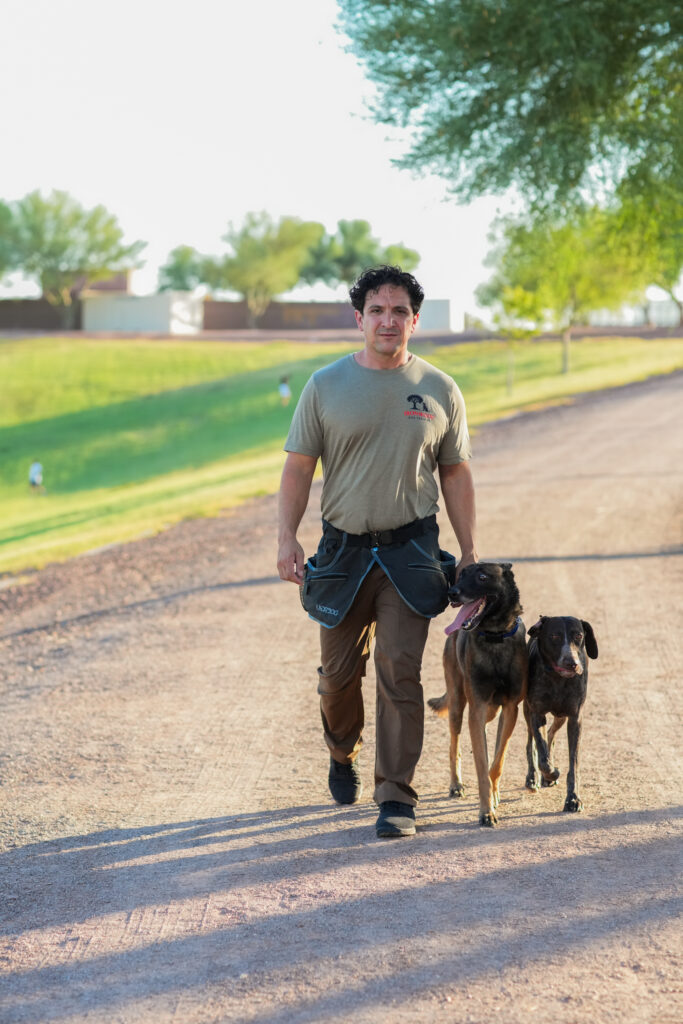
Reactive Dog Leash Training Is Arousal Work, Not Manners Work
Reactive dog leash training addresses how your dog feels about a trigger, not how politely they walk. Barking and lunging are the visible end of an arousal response that started well before you saw it. Effective work happens below threshold, at whatever distance still lets your dog eat, think, and respond.
The practical core of it is not complicated, though it does require patience:
- Find the distance where your dog can still function. Not the distance where they look fine. The distance where they will still take food and still answer a cue. That is your working distance, and it is usually further than people expect.
- Pair the trigger with something valuable, in that order. Trigger appears, then food arrives. The sequence matters. You are changing what the sight of another dog predicts.
- Close the gap slowly, and only on the dog’s evidence. If recovery time goes up, you moved too fast. Back off and rebuild.
- Protect the training from surprise encounters. One bad ambush can undo a week. In Phoenix that means choosing your routes and hours deliberately.
I will be direct about tools, because owners ask constantly. We do not use prong collars or e-collars as our primary tools, and we do not use them for reactivity. Not because of ideology, but because of what the mechanism actually does. Adding discomfort at the exact moment a dog is already over threshold raises arousal and adds a negative association to whatever the dog is looking at. You can absolutely stop a dog from barking that way. What you have changed is the display, not the state underneath it.
Suppressing the bark does not lower the arousal underneath it. It just removes your early warning.
An honest limit, too. Some reactivity is not primarily a training problem. If your dog’s response involves sustained fear, panic, or a bite history, or if the intensity seems disproportionate to anything in the environment, that dog may need a veterinary behaviorist working alongside the training rather than a trainer alone. We will tell you if we think that is the case rather than sell you a package that will not solve it.
Leash Training for Dogs in a Phoenix Summer
Phoenix heat compresses leash training for dogs into a narrow window at dawn and after dark. That window is also when every other dog owner in the neighborhood is outside. So your only available training time is also the time with the highest density of triggers, which is a genuinely hard problem and worth planning around.
This is the local reality that generic leash advice never accounts for. The city takes summer heat seriously enough to legislate around it: under the City of Phoenix Trail Heat Safety Program, specific trails at Camelback, Piestewa Peak, and South Mountain are restricted from 8 a.m. to 5 p.m. whenever the National Weather Service issues an Extreme Heat Warning. In 2024 the city logged 45 days of those restrictions between May and October, with 121 days at or above 105°F and 69 days above 110°F.
Translated into training terms: for roughly a third of the year, your outdoor reps live in two short windows, both of them busy. Here is how we work around that.
- Move the arousal work indoors. Recovery training, pattern behaviors, and impulse control need almost no space and zero heat exposure. Do those at 3 p.m. in the air conditioning and save the outdoor window for exposure work.
- Shorten the reps, not the frequency. Three four-minute sessions beat one twenty-minute walk, especially in July, and short sessions are also easier on an over-aroused dog.
- Use covered structures. Shaded parking garages and covered walkways give you low-distraction, heat-protected practice space. This is one of the more useful things I can tell Phoenix owners.
- Check the pavement with your hand. Seven seconds on the asphalt with the back of your hand. If you cannot hold it, your dog should not be standing on it.
- Plan for monsoon season. July through September brings storms, and sound sensitivity spikes for a lot of dogs. If your dog gets worse on the leash in August, the barometer and the thunder may be doing more of the work than you think.
There is a silver lining here that I point out to owners every summer. A dog who cannot be walked much has to get their stimulation somewhere, and nosework does that better than distance. Scent work is more tiring than a long walk for most dogs, it is completely heat-independent, and it lowers baseline arousal rather than raising it. Ten minutes of finding things in the house is worth more in July than a mile of pulling.
How We Structure Leash and Obedience Training in Phoenix
We build leash skills in the order the dog can absorb them: baseline assessment first, mechanical skill at low arousal second, recovery training third, and graduated real-world exposure last. Owner coaching runs through all four, because the training only holds if the person can reproduce it without us.
- Assessment. Where does your dog sit at rest, what sets them off, and how long do they take to come back down? That last number is the one nobody measures and the one that predicts the most.
- Mechanical foundation. Position, movement, and the value of a loose line, built through positive reinforcement in an environment quiet enough for the dog to succeed.
- Recovery reps. Deliberate arousal spikes with trained returns, exactly as described above.
- Graduated exposure. Real distractions, introduced at a distance the dog can handle and closed slowly. Skills do not generalize on their own; they have to be rebuilt in each new context.
- Owner handoff. Timing, mechanics, reading your own dog, and what to do when a walk goes badly. This is not a five-minute walkthrough at the end.
Which program that lives in depends on your dog and your schedule. Leash work is the backbone of our basic obedience training in Phoenix. When a dog needs daily repetition and the owner’s week cannot support it, our board and train program is usually the better fit. If you are starting with a young dog, building the loose line before a pulling history exists is far easier than undoing one later, which is what our puppy training program is built around. And the arousal control described in this article is the same skill set we develop for the ring in competition training — the difference is precision, not principle.
One thing worth saying plainly: none of this is fast, and I would be careful with anyone who tells you it is. Owners who work recovery and exposure consistently usually see meaningful change inside a few weeks. Owners who train hard for four days and then take a week off generally do not, and that is not a failure of the dog.
“Buddy was biting our kids’ hands and jumping on everyone who came over. I was worried he’d never learn. But the trainer taught him ‘gentle’ and ‘off’ commands that actually work. My 7-year-old can now play with him safely. It took about a month, but the change is incredible. Buddy still has puppy energy but he’s not wild anymore.”
I include that review here on purpose. Jumping and mouthing are arousal problems wearing different clothes. Buddy did not lose his energy — his owners describe him as still having plenty. What changed is that he acquired an off switch. That is the same mechanism that makes a leash go slack.
Frequently Asked Questions
How long does dog leash training in Phoenix take?
Most dogs show clear improvement within three to four weeks of short, consistent daily sessions. Dogs with a long pulling history or established reactivity take longer. A better progress marker than the calendar is recovery time: how quickly your dog can take food again after a trigger passes.
Is my dog reactive or just overexcited?
Check whether your dog can still eat and still answer a known cue near the trigger. An excited dog usually can, with effort. A reactive dog generally cannot, and takes much longer to settle afterward. The training approach is similar either way; the distances and timelines are not.
Do you use prong collars or e-collars for leash training?
No, not as primary tools and not for reactivity. Adding discomfort while a dog is already over threshold tends to raise arousal and attach a negative association to whatever they are looking at. It can suppress the barking. It does not change the underlying state driving it.
What equipment do you recommend for loose leash walking?
A well-fitted harness and a standard six-foot leash cover most dogs. A front-clip harness can reduce forward leverage while the behavior is being built. Equipment buys you management, not training. Choose whatever keeps you both safe while the actual skill gets taught.
When is it too hot for leash training outside in Phoenix?
Use the pavement test: press the back of your hand to the asphalt for seven seconds. If you cannot hold it, neither can your dog’s paws. During Extreme Heat Warnings the city also restricts several popular trails from 8 a.m. to 5 p.m. On those days, train arousal control indoors instead.
Does sport dog training really apply to a normal family pet?
The principles do. Sport handlers spend serious time teaching dogs to raise and lower arousal on cue, because competition demands it. Family dogs need the same skill for a walk past three barking dogs — the standard is lower, the mechanism is identical, and pet owners are rarely taught it.