
Is your new dog chewing your favorite shoes, ignoring you when you call, or dragging you down the block on walks? You’re not alone. A lot of new dog owners in Phoenix feel overwhelmed at first—and that’s completely normal.
The good news: training doesn’t have to be complicated or intimidating. When you understand how dogs learn, you can build real-life skills and a strong bond at the same time.
At Ironwood Dog Training in Phoenix, we keep training simple, science-based, and fear-free. This beginner’s guide walks you through the fundamentals and gives you a clear plan you can start today.
1) What Actually Works: The Science Behind Fear‑Free Training
Let’s retire the outdated “dominance” myths and harsh corrections. Modern dog training is grounded in behavioral science—mainly Classical Conditioning (associations) and Operant Conditioning (consequences).
Think of it like teaching your dog a new language. Your job is to make the “right answer” easy, and make it pay off.
Our guiding philosophy is simple:
Rewarding desired behaviors creates a calm, low-stress environment where dogs learn willingly.
Positive reinforcement training works best when you focus on three core principles:
Timing matters more than you think
Dogs connect actions with outcomes fast. If you want a behavior to stick, the reward should happen within 1–3 seconds of the behavior.
Example: The moment your dog’s butt hits the floor for “sit,” mark it (“Yes!” or click) and reward right away.
Consistency prevents confusion
Dogs don’t generalize the way humans do. Mixed signals slow everything down.
Pick one cue per behavior (and one hand signal if you use them). Make sure everyone in your home uses the same words. “Stay,” “wait,” and “hold on” all mean different things is fine—using them interchangeably is not.
Reinforcement builds trust
We focus on teaching what to do, not punishing what you don’t want.
Instead of scolding jumping, teach an incompatible behavior like “sit to say hi.” Your dog learns a clear path to success, and your relationship stays strong.
Why Ironwood’s approach works: In Phoenix and across the Valley, we’ve seen fear-free methods reliably improve real-world issues—like barking, leash pulling, and unreliable recall—without damaging trust.
2) Your Step‑by‑Step Beginner Training Plan
Here’s a simple program that builds skills quickly without overwhelming you or your dog.
Training setup (keep it easy)
- Treats: Use small, high-value treats (tiny pieces of chicken, cheese, or soft training treats).
- Marker: A clicker is great, but a consistent word like “Yes!” works too.
- Sessions: Keep sessions under 5 minutes.
- Frequency: Do 2–3 short sessions per day.
- Start with low distractions: Begin in your living room, then level up to your Phoenix backyard, then parks or sidewalks.
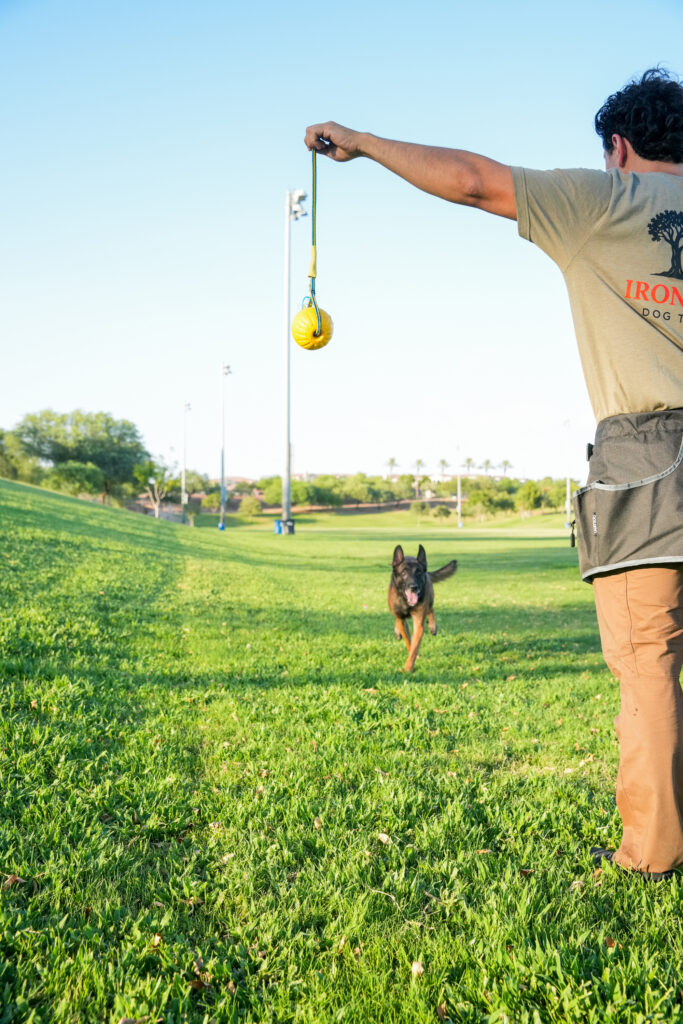
(1) Teach the foundation cues: Sit, Stay, Come
Sit
- Hold a treat near your dog’s nose.
- Slowly move it up and back.
- The instant your dog sits, mark (“Yes!”/click) and reward.
- Add the cue “Sit” only when the motion is predictable.
Stay (start small)
- Ask for “Sit.”
- Pause for one second.
- Mark and reward while your dog stays put.
- Gradually add time, then add distance, then add distractions (in that order).
Come (recall: make it worth it)
- Start close—just a few feet away.
- Say “Come!” once, in a happy voice.
- When your dog turns toward you, mark and reward.
- Reward again when they arrive. Make coming to you feel like hitting the jackpot.
Pro tip: Never call your dog to you for something they hate (like nail trims) unless you can make it worth it afterward. Protect the cue.
Real‑world Dog case study: “Max,” a rescue dog
Max was unsure and hesitant. We started by rewarding tiny wins—like eye contact and choosing to move toward us. Then we paired the cue (“Max, come!”) with generous reinforcement. As he improved, we gradually increased distance and distractions and began rewarding intermittently so recall became a habit—not just a food transaction.
(2) Teach polite leash walking and social confidence
The Ironwood “No‑Pull” technique
This method is simple and effective:
- The moment your dog pulls and the leash goes tight, stop walking.
Become a tree. - Wait quietly until you get any slack—even a glance back counts at first.
- The instant the leash loosens, mark, praise, and move forward.
Your dog learns:
- Pulling = walk stops
- Loose leash = walk continues
Helpful gear: Many beginners do better with a front-clip harness (not a choke chain). It makes it easier to reinforce good walking without a wrestling match.
Common beginner problems (and what to do instead)
| Problem | What doesn’t help | The positive solution that works |
| Excessive barking | Yelling back | Don’t reward barking with attention. The moment your dog pauses, say “Quiet” and reward the silence. Practice “quiet” during calm moments first. |
| Chewing furniture | Scolding after the fact | Dog-proof your space. Provide approved chew options. Teach “Leave it” and reward heavily for choosing their toy instead of your table leg. |
| Potty accidents | Rubbing their nose in it | Use a schedule: after meals, after play, after waking up. Supervise indoors. When they go outside, throw a “potty party” (treats + happy praise). |
| Separation anxiety | Big emotional goodbyes | Practice short, boring departures. Give a long-lasting enrichment item (like a stuffed Kong) as you leave. Don’t punish anxiety behaviors when you return. |
Build social confidence the right way
A well-socialized dog isn’t “social with everyone.” They’re comfortable in everyday life.
Expose your dog gradually to:
- new people (at a safe distance)
- sounds (traffic, bikes, kids playing)
- surfaces (gravel, tile, grass)
- environments (parks, patios, busy sidewalks)
- friendly, vaccinated dogs (when appropriate)
This is a major focus of our good dog puppy training program (8 weeks to 6 months), designed to help dogs thrive in Phoenix’s active urban and desert environments.
3) Want Faster Progress With Expert Support?
You now have a strong foundation to start training with positive reinforcement. If you want faster results—and a plan customized to your dog—professional guidance can make a big difference.
Take the next step with Ironwood Dog Training, Phoenix’s trusted name in fear‑free, science‑based training.
Contact us for a Professional Behavior Assessment: (602) 520‑7364
During your consultation, you’ll receive:
- A personalized training plan based on your dog’s breed, age, temperament, and your lifestyle goals
- Support from a community of trainers and dog owners committed to positive methods
- Two weeks of follow‑up support to help your training stick at home and out in Phoenix neighborhoods